Track 1
Getting more Adaptive in Optimization expand description
In each version optimizer becomes smarter and smarter.
Since 12C it can change its mind on the fly. But how does it do it?
What features help him to choose the best plan?
All you wanted to know about Adaptive Query Optimization in 12c/18c in one short session, with lots of examples and sence of humour
Join us and start the adventure!
Usually people and companies don’t care about security (or securing their systems) until the day they got attacked or have their private data leaked. The idea of this session is to show how we are vulnerable to attackers and the ways they use to get inside our databases, specially using rootkits.
In this presentation I will cover the systematic approach of solving Oracle performance issue. I will show a difference between AWR and Active Session History ( plus ashtop / ash_wait_chains script created by Tanel Poder ) and I will explain how to drill down a problem until you find a root cause.
Track 2
MySQL 8.0 Community – Ready for GDPR ? expand description
One of the most topical subject today is security. New MySQL 8.0 version introduces several improvements about that, such as: • Encryption of Undo and Redo logs • Password rotation policy • New caching_sha2_password plugin • SQL Roles So… let’s have a look!
One reason for poor query performance are bad written SQL statements. In this entertaining session, you will see some scary “horror queries”, but also solutions how to rewrite them to simpler and much faster SQL statements. A typical approach for performance tuning is: Keep your SQL simple and fast.
Track 1
Keep them out of the database! expand description
Is it a no-brainer for a DBA to prevent unwanted connections to an Oracle database in a complex environment ? What are the essential aspects to understand ? What kind of technical solutions exist ? In the form of a discussion, Martin and Flora address important organizational and technical issues.
Track 2
Automatic indexing and what else is new in 19c expand description
I was beta tester of 19c and ADW/ATP. The talk will cover what is new in autonomous in addition to hybrid tables, real-time statistics, automatic resolution of SQL plan regression, Data Pump, the new 19c parameters, etc.
Track 3
Calling userdefined functions from SQL queries got faster in Oracle 12c. expand description
Version 12 of the Oracle database introduced some options that make executing PLSQL functions within SQL queries faster than ever before. This presentation will show how and when use to use the features, the performance gains and it will highlight the pitfalls that can be encountered.
Track 1
From Transportable Tablespaces to Pluggable Databases expand description
After explaining the similitudes and differences between Transportable Tablespaces and PDB unplug/plug, the focus in on the multitenant features for clones and migrations, with demos of PDB online clone, remote clone, refreshable PDB clones, PDB relocate. Some are available without option and even in Standard Edition.
Track 2
Oracle Database high availability from client perspective expand description
We will look deep into high availability technologies Oracle RAC provides, what actually happens during database failover or planned maintenance and how to configure database services so that Java applications experience no or minimal disruption during planned maintenance or unplanned downtime.
Track 3
How to make your daily rutine, code and database more efficient expand description
Databases in the cloud are not using magic and need same DBA attention in terms performance and monitoring. Monitoring is complicated for PaaS model like AWS RDS but still possible. Talk will cover a monitoring functionality build by AWS to monitor different RDS dababases using wait events.
Track 1
Oracle Partitioning for DBAs and Developers. Why, when and how to use it? expand description
Most VLDBs should use partitioning and in today’s world scaling up and out a database is something critical, so every DBA and Developer should work together to accomplish this task. Partitioning may help the application run faster and also helps DBAs to perform their work.
Track 2
Little Red Riding Hood and the Data Thief expand description
We prepared the talk for 2 speakers & aim at many live demos as possible: One will try to protect data, the other will try to steal data. We will show demos how to implement VPD by using DBMS_RLS & sys_context. We stress that it is included in XE & the importance of the principle of least privilege.
Track 3
Test your PLSQL - your database will love you expand description
Want to learn how to bring quality and maintainability into your project? Join my session to find out how to make unit testing part of delivery process and avoid irritating bugs and slow QA process. In this session you will see a live demo of utPLSQL testing as part of software delivery life cycle
Track 1
REST Enabling your Oracle Database expand description
You need Web Services for your Oracle Database. You don’t have extra money, and you want to leverage your SQL and PL/SQL skills. But it also needs to be secure, fast, and REST/HTTP compliant - and communicate via {JSON}.
This talk will show you how to setup and use Oracle REST Data Services.
There was this twisted written query and no time to fix it. I had to throw a sql profile on it to make it perform. To achieve this, I had to turn the execution plan inside out. I thought “if I can fix this mess, I call my self MacGyver.”
This presentation focuses on the issues behind the insecure code out in the wild. We will move through sql injection attacks and how they occur and the coding methods to defend against sql injection.
Track 3
APEX's classic report: the power of no template expand description
The classic report is on of the APEX components that are a bit undervalued. It offers great potential when you must adjust the generated HTML after it has been sent to the browser. The session will introduce concepts for creating highly adjustable reports which allow lots of user interaction.
Knowing the fundamentals of how Oracle works will help you be a better developer or DBA. It’s not complex, but you have probably never been told before. This session will tell you. And I make it fun.
Track 2
DBFS - savior or pitfall... expand description
Is DBFS for you? What are the cons and pros of using DBFS? This talk will address these questions based on the day to day usage of DBFS for multiple systems, with the primary goal of addressing ETL processing. Rarely used feature, may well address your requirements or may cause headaches.
Track 3
FABE the largest world wide APEX community project expand description
Doing a community project includes a lot of challenges:
- work life balance / prioritization / expectations
- multi cultural / different timezone interaction
- new technical challenges
- database inside the cloud
I will share my view about this great project and what it means to participate in a community project.
Track 1
SQL Optimization Walk Through expand description
We’ll take a real SQL (or maybe two) and will walk through the steps needed to understand why SQL is running slower than it can, why Oracle is doing what it does, and possible solutions for these issues.
Track 2
The database platform – the end of progress? expand description
Not any new processors? Not any new disk arrays? The same SAN till the end of the time? Moor’s low not working anymore? Marketing instead of technology?
Over the last decades the enterprise class systems, and database systems as a part of it, was perceived as IT market locomotive.
It was reflected by technology trends, strong attention of most important vendors and – as a result - wide offer of new announced, truly innovative products.
The IT market is still growing dynamically and cover wider area of technology and users activities. The grow caused as an effect deep structural market rebuilding, which has close the market of enterprise solutions as narrow and shrinking niche. The consequences of it make important changes to Enterprise Solutions Market, IT environments and actual availability of new technologies. I have tried to summarize the prominent (and natural) trends from wilder perspective because we, professionals caring about business critical solutions deeply depends of them.
Track 3
Accelerate Development with automation expand description
In this presentation Ron will discuss DevOps and the explore why automation is key to developer agility. Ron will demonstrate how automation can accelerate development and improve quality by ensuring consistent platform configurations and by delivering the right data to the right people, fast!
Track 1
Deep Dive into the Implementation of Oracle's Join Methods: Past, Present and Future expand description
Join processing in relational databases involves combining the output of two row sources (e.g. tables) into one result row source. Most SQL analytic workloads are dominated by time spent in join processing because of the nature of the operation being heavily compute and bandwidth intensive. Oracle has developed numerous traditional join methods over the years (e.g. nested loop, sort merge, hash joins, etc.). Some of these methods have fallen out of favor over time by the optimizer (i.e. past), others are time-tested and commonly selected by the optimizer to this day (present), and then there's a new class of join algorithms which leverage the latest In-Memory Columnar data formats to deliver the fastest join evaluation known in industry (future). This talk will dive into the technical implementation details of Oracle's plurality of join methods (including specialized ones such as vector transformation which optimizes aggregations over joins), give insight into why the optimizer may choose one method over the other, and what the SQL and storage engines are actually doing under the hood to implement the join.
Track 2
We are Serverless - It still Works. And this (what we think) has happened. expand description
Going Serverless to a cloud-provider gave use some interesting experiences. The result was Positive, but with interesting lessons about the tools (java, pl/sql, python, docker and lambdas), the data, the (oracle-)database, and the people and processes needed to control the new situation.
SQL is in Relational Databases what PGQL is in the Graph Databases world (Oracle-wise). Did you ever think at challenging both solution? Doing the same job, compare how nice, easy, fast it is. Let’s see how it goes…
Track 2
Home Management and database patching with RHP expand description
How to manage multiple of Oracle homes?
How to patch or upgrade many of databases?
Can it be done with a single button click?
The session will demonstrate the way to answer above questions using the Rapid Home Provisioning server. The main focus will be on the RHP functionalities that do not require additional licencing.
Track 3
Conquer Big Data with Oracle 18c, In-Memory External Tables and Analytic Functions expand description
There’s an onslaught of Big Data coming to our IT shops - zettabytes of it! – but instead of your application developers struggling to learn new languages and techniques to analyze it, why not leverage Oracle Database 18c?
Track 1
A deep dive into Oracle parsing expand description
As a spoiler/teaser: the documentation is mostly wrong about it, and certain critical parts of parsing can be moved to execution time. Because what is happening is generally considered to be taking place at parsing time, that time is now spend in in sql execution in the statistics, however since it’s considered parsing, that time is added to parsing time too, making it hard if not impossible to understand the statistics if there are actual parsing problems.
Track 2
Long live to CMAN! Or why Oracle still cares about CMAN and why you should do it too expand description
Oracle Connection Manager (CMAN) is the Swiss-army knife for database connections. Starting with Oracle 18c, it has been extended with the new Traffic Director Mode (CMAN TDM), that allows transparent failover for applications that do not implement it natively. Come to this session to know more!
Track 3
A Gentle Introduction to Polymorphic Table Functions expand description
Oracle database 18c introduces Polymorphic Table Functions. This session will tell you about Polymorphism and how you could apply this in pre-18c databases. After this session you will understand when to use which technique.
Track 1
ASH and AWR: beyond ?/rdbms/admin/{awrrpt,ashrpt.sql} expand description
Oracle EE systems licensed to use the Diagnostics Pack offer a wealth of tools to assess performance. Analysts often resort to ASH and AWR reports, and often stop right there. Yet there is more! This talk features scripts contributed by renown performance experts helping you find problems quickly.
Track 2
Oracle XE - The world's best database completely free expand description
If you need a reliable database, but unsure about license costs, Oracle XE is for you.
This presentation will show you what you can do with Oracle XE, APEX, and new features as advanced analytics. The presentation is aimed at beginners, and people who mistakenly believe Oracle has to be expensive.
l’ve been benchmarking ORDS. I’ll cover why, how, and
things I’ve learnt along the way, including using reverse proxies to
cache responses and handle SSL certificates. I’ll share details of my
Vagrant build so you can check my findings. I’m assuming attendees
will have basic knowledge of ORDS.
Track 2
What's used in your database? the value available behind DBA_FEATURE_USAGE_STATISTICS expand description
Everyone who had to go through a Oracle DBA Training knows the existence of DBA_FEATURE_USAGE_STATISTICS. If you have to take care of features used, inflexible regime of DFUS is boring. If you want to understand the moving parts behind the scene, this presentation will help you to reach your goal.
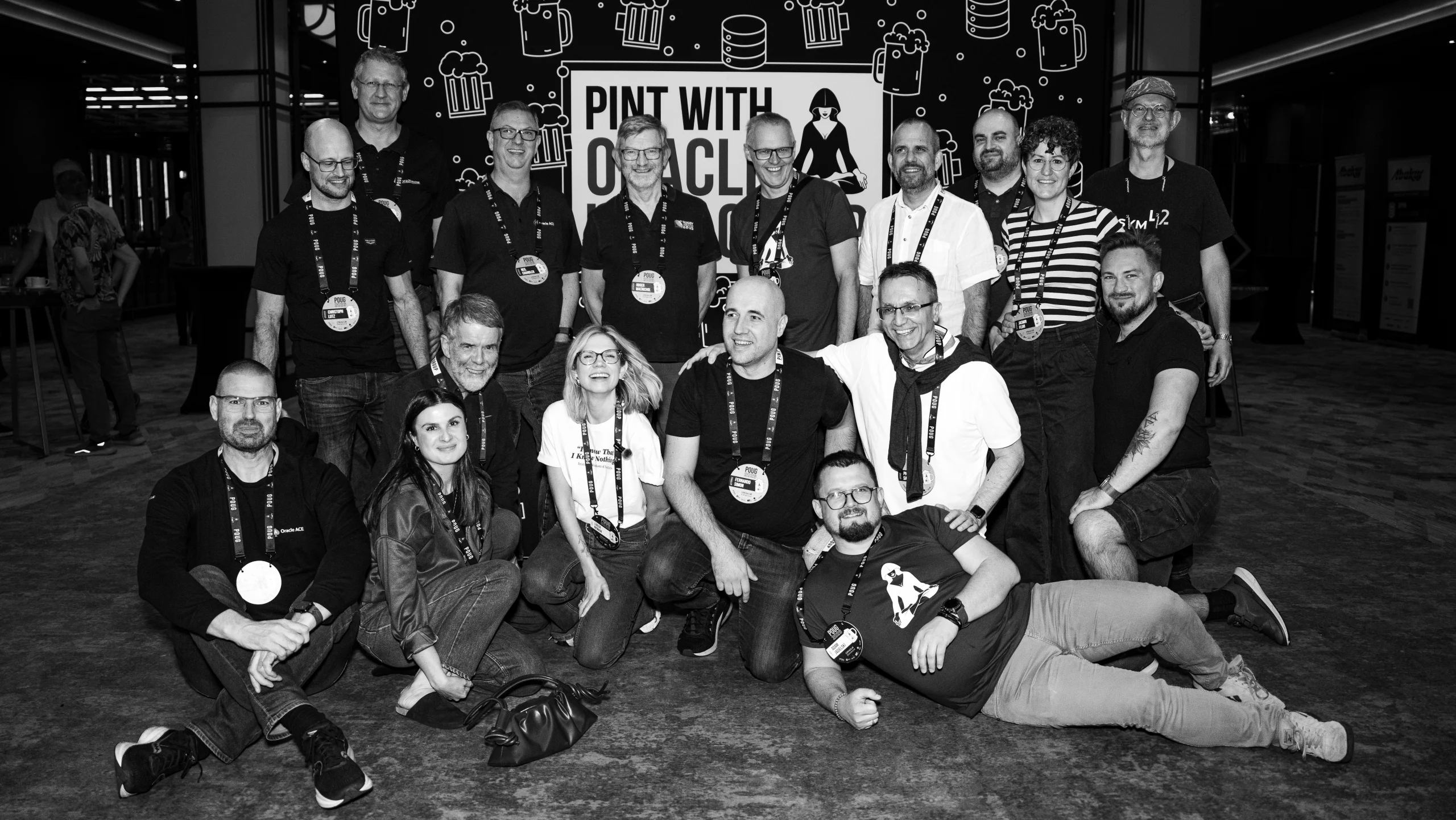
POUG is not only the official Oracle community – first of all it is the base of very active members, who are engaged in the group development both during the meetings and the preparations to them. Our message gets to the 400 people connected with databases – from the developers to the administrators and from the begginers to the experts with years of experience.
We would like to invite you to be a part of our event – it is a chance to show your brand during and before the meeting.
Ta strona wykorzystuje własne pliki cookies, aby działać prawidłowo. Korzysta też z plików cookies podmiotów trzecich, dostarczających narzędzia marketingowe, usługę newslettera, odtwarzacze wideo, mapy oraz narzędzia analityczne. Do informacji zbieranych w cookies podmiotów trzecich mają dostęp dostawcy tych narzędzi. Czy zgadzasz się na korzystanie z innych niż niezbędne plików cookies zgodnie z polityką prywatności?
If you’re visiting this site, it’s a sign that you value your privacy. To meet your expectations, this page has implemented a mechanism that allows you to control the use of cookies and other tracking technologies.
First-party cookies are used on this site to ensure the proper functioning of certain website features, and third-party cookies are used to utilize external tools as described in detail in our privacy policy.
If you want to accept all cookies used here, click the button below.
These cookies are always active, and you cannot opt out of them. These include cookies that ensure the proper functioning of features like forms on the site, the user account login mechanism, and maintaining sessions after logging in. Additionally, your cookie settings are stored in first-party cookies.
We use Google Analytics, a tool that allows us to collect, review, and analyze statistics related to user activity on our website. The Google Analytics tracking code collects information about your activity on our website, which Google may use to build your user profile. Additionally, Google Analytics data may be used in ad campaign settings with Google Ads. If you do not wish for this, you can disable Google tools.
We use Facebook marketing tools. Therefore, we have embedded Facebook's analytical scripts (Facebook Pixel) on the website, which collect information about your activity on this site and your IP address. Based on the information gathered, Facebook allows for setting up ads with advanced targeting options. If you do not wish for this, you can disable Facebook's analytical scripts.
We use multimedia from YouTube on this site. The players for this multimedia use cookies from their provider. The provider may access the information stored in the cookies and your IP address. This information is used to ensure the proper functioning of the players and for analytical purposes. You can choose not to allow cookies related to the players, but in that case, you will not be able to view the embedded multimedia content.
We use Google Maps on the site. These maps use cookies provided by the service provider to function correctly. The service provider may access the information collected in these cookies, as well as your IP address. You can disable the cookies related to maps, but if you do, you will not be able to view the maps on our website.
Osadziliśmy na stronie formularz pozwalający Ci zapisać się do naszego newslettera. Formularz wykorzystuje do swojego prawidłowego działania pliki cookies pochodzące od dostawcy systemu newsletterowego MailerLite. Dostawca może uzyskiwać dostęp do informacji gromadzonych w plikach cookies oraz Twojego adresu IP. Informacje te wykorzystywane są w celu zapewnienia prawidłowego działania formularza oraz w celach analitycznych. Możesz wyłączyć pliki cookies związane z formularzem, ale w takiej sytuacji nie będziesz w stanie zapisać się do newslettera.